Mikromasch

Metal-air battery technology could offer very high energy density, and is considered a promising candidate for “beyond Li-ion” next-generation batteries. Aluminum, which is abundant and cheap, is a likely anode material. Aluminum-air batteries have a theoretical specific energy of up to 8.1 kWh/kg, second only to lithium-air batteries (13.0 kWh/kg).

A pioneer in the aluminum-air field is the Israeli startup Phinergy, which formed a joint development agreement with aluminum giant Alcoa last February.

Now, Fuji Pigment says it has developed a new type of aluminum-air battery that can be recharged by refilling with salt or fresh water, and that it plans to commercialize the product by spring 2015. Dr. Ryohei Mori developed the technology, and described it in a paper in theJournal of the Electrochemical Society.

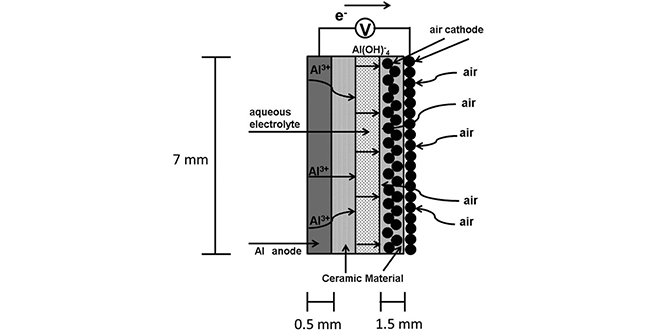
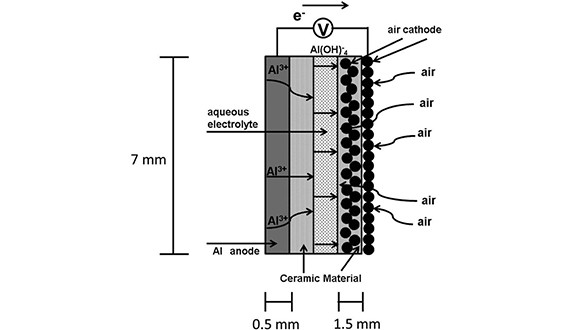
One problem with aluminum-air technology is parasitic hydrogen evolution caused by anode corrosion during discharge. To address this, Dr. Mori modified the battery structure by placing ceramic and carbonaceous materials between aqueous electrolyte and electrodes as an internal layer. This modified structure suppresses anode corrosion and by-product accumulation, resulting in longer battery life.

“In an earlier work, we demonstrated the use of ceramic aluminum ion conductors in preventing anodic corrosion while maintaining aluminum ion conductivity,” writes Dr. Mori. “We used Al2(WO4)3 as an aluminum ion conductor for both the anode and the air cathode. An aluminum-air battery with a rechargeable battery was fabricated, and its properties were stable for one month. We named this cell an ALFA cell.”

“During this study, we noticed that Al2(WO4)3 had an intrinsic electrical conductivity of nearly 4 × 10⁻⁶ S cm−1 at 600◦ C; however, its conductivity was not high at room temperature. We found that the liquid electrolyte had penetrated the solid electrolyte region (the space between the ceramic particles), reaching the electrode. It was thus considered possible to fabricate a rechargeable aluminum–air battery with an insulating material, such as aluminum oxide, in order to replace the solid electrolyte.

“In our previous study, aqueous NaCl was used as an electrolyte. In the present study, we used NaOH and KOH to investigate the functionality of the ALFA cell and to verify the validity of our assumptions. Another aspect considered was that the major drawback of a metal-air battery is evaporation of its liquid electrolyte. Therefore, to investigate the possibility of preventing liquid electrolyte evaporation in the ALFA cell, we added glycerin to aqueous NaCl solution.”


Source: Journal of the Electrochemical Society via Green Car Congress
Image courtesy of Mori 2015
January 15, 2015

Fuji Pigment develops new type of aluminum-air battery

Metal-air battery technology could offer very high energy density, and is considered a promising candidate for “beyond Li-ion” next-generation batteries. Aluminum, which is abundant and cheap, is a likely anode material. Aluminum-air batteries have a theoretical specific energy of up to 8.1 kWh/kg, second only to lithium-air batteries (13.0 kWh/kg). […]
November 8, 2014

Researchers gain fundamental insight into key reaction for Li-air batteries

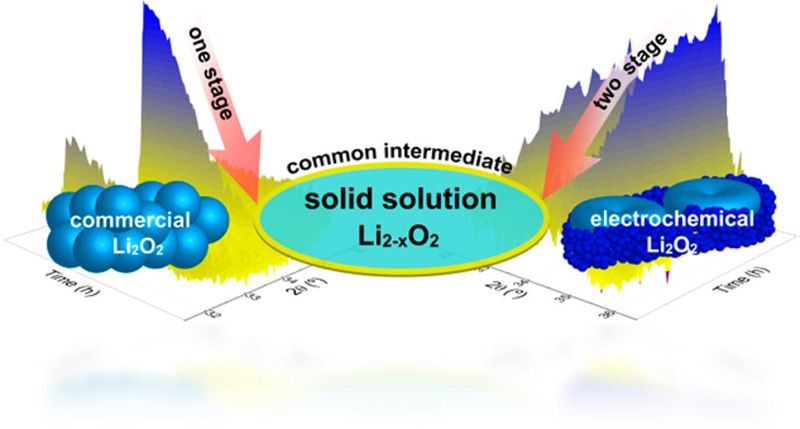
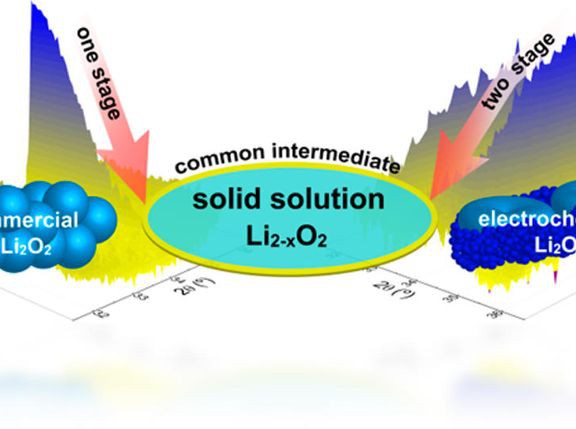
A team from Delft University in The Netherlands and the University of Waterloo in Canada has used operando X-ray diffraction to show that oxidation of electrochemically-generated Li2O2 in high energy density Li-air batteries occurs in two stages, but in only one step for commercial (crystalline) Li2O2. This discovery reveals a […]
October 3, 2014

This air-breathing solar panel stores its own electricity, cutting the cost of solar power significantly

It’s a solar cell! No… it’s a rechargeable lithium-air battery! No… wait… it’s both: It’s the world’s first all-in-one solar battery! The new device, developed by Ohio State University, is essentially an air-breathing lithium battery that recharges via a built-in solar cell. This is significant, because one of the biggest problems […]
March 26, 2014

Lithium-Air Batteries Planned By Volkswagen

It has been confirmed that Volkswagen is working on a powerful new battery for its EV fleet. Speaking at the Geneva Motor Show, Dr. Heinz-Jakob Neusser said that “an 80kWh unit is under development using our own technology. It would provide between three and four times the battery power in a given package.” […]
March 19, 2014

Lithium-air battery pushed as electric vehicle breakthrough

Research presented at the meeting of the America Chemical Society suggests that the current dominant technology for electric vehicles, lithium-ion, could be surpassed by batteries employing air as the cathode. At present most electric vehicles on the market today have a range less than 200km on a single charge. To […]
November 13, 2013

Better batteries through biology?

Lithium-air batteries have become a hot research area in recent years: They hold the promise of drastically increasing power per battery weight, which could lead, for example, to electric cars with a much greater driving range. But bringing that promise to reality has faced a number of challenges, including the […]
April 20, 2012

IBM creates breathing, high-density, light-weight lithium-air battery

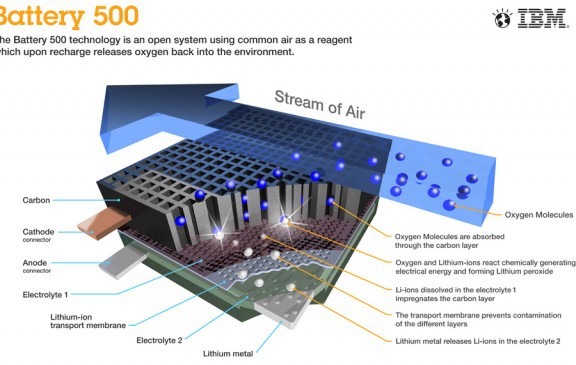
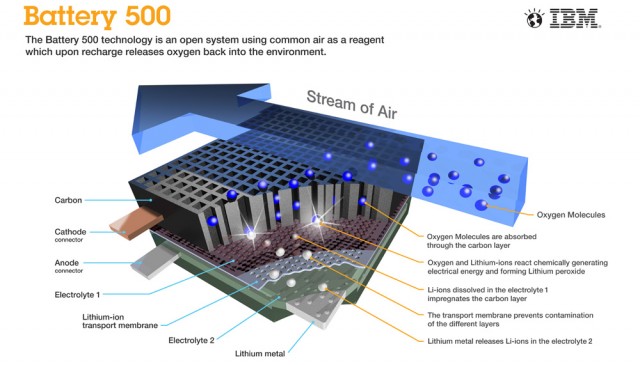
As part of its Battery 500 project — an initiative started by IBM in 2009 to produce a battery capable of powering a car for 500 miles — Big Blue has successfully demonstrated a light-weight, ultra-high-density, lithium-air battery. In IBM’s lithium-air battery, oxygen is reacted with lithium to create lithium […]